 English
 Espanol
 简体中文
简体中文 Tagalog
 հայերեն
 한국인
한국인 Tiếng Việt
 فارسی
فارسی русский
 日本
日本 عربي
عربي
Breast Cancer Screening Guidelines & Diagnosis
Whether you are just beginning regular cancer screenings or are at a stage where you need a diagnosis, our Jim and Eleanor Randall Breast Center is the best imaging partner for you. We also welcome the opportunity to provide you the second opinion you deserve.
Jim and Eleanor Randall Breast Center for Imaging
The Jim and Eleanor Randall Breast Center is operated by Huntington Health and staffed by expert radiologists from RadNet. Our patients receive rapid access to diagnostics and screening with state-of-the-art technology and expert care for the highest quality breast imaging services.
We are thankful for Jim and Eleanor Randall’s significant endowment to support the work and care taking place at the Breast Center. The Randall endowment for breast care has provided the funds necessary to support ongoing excellence in breast cancer diagnosis and treatment within the breast center. A portion of the funds were allocated to support new diagnostic services, which included Digital Breast Tomosynthesis. Also known as 3D mammography, TOMO is an effective screening option for women with dense or extremely dense breasts, or who have been determined to have a higher lifetime risk of breast cancer.

The Jim and Eleanor Randall Breast Center provides a tranquil spa-like atmosphere in an effort to reduce anxiety and create a calm and comfortable environment. The radiologists and staff are dedicated to finding breast cancer at an early stage by providing state-of-the-art digital mammography, stereotactic biopsy, MRI, and ultrasounds.
We have nurse navigators whose priority is to assist patients who have been diagnosed with breast cancer and follow them through their diagnosis, treatment, and beyond. Bone Densitometry is also offered as a simple and proven x-ray method offered to detect osteoporosis. It is considered one of the finest women’s health care centers in Southern California.
625 S. Fair Oaks Ave, Suite 140
Pasadena, CA 91105
- Scheduling: (626) 793-6141
- Fax: (626) 796-0172
In addition to simple and convenient appointment bookings, the Jim and Eleanor Randall Breast Center offers:
- Expert imaging and advanced technology to provide fast results and turnaround times.
- RadNet’s approach to innovative screening and prevention, including:
- A Comprehensive Risk Assessment program with personalized screenings and early detection of potential cancer risks.
- An Enhanced Breast Cancer Detection Program, which has enabled the early detection of potential cancer risks.
- Trusted medical directors, Heather Moreno, MD (pictured below left with radiologist Geraldine Chang, MD), and Gita Varaprasathan, MD, who have long served our community, understand the unique needs of our patients and are dedicated to delivering compassionate, expert care.

Randall Breast Center is Under New Management
For 133 years, Huntington Health has proudly served the San Gabriel Valley with compassionate, high-quality care. Our legacy is rooted in a deep commitment to excellence and a continuous effort to enhance the services we provide to our patients and their families.
As part of this commitment, beginning August 1, 2025, professional radiology services at the Jim & Eleanor Randall Breast Center will transition to Beverly Radiology Medical Group and management of the center will transition to RadNet, a leading regional provider of outpatient diagnostic imaging services.
“This relationship with RadNet represents a significant step forward in our mission to deliver world-class cancer care close to home,” said Howard Kaufman, MD, MBA, Regional Medical Director of Huntington Cancer Center, an affiliate of Cedars-Sinai Cancer. “By providing access to advanced imaging, accelerating diagnoses, and expanding preventive services, we are strengthening our ability to detect breast cancer earlier and support patients through every stage of their journey. Our community deserves nothing less than excellence—and we are committed to delivering on that promise.”
Breast Cancer Diagnosis
Receiving a cancer diagnosis is always challenging, and you may experience feelings of shock, anger, disbelief, grief and uncertainty.
Rest assured that state-of-the-art diagnostic technologies, delivered by our partners at the James and Eleanor Randall Breast Center mean more cancers are found at their earliest, treatable stages when more treatment options are available and survival chances are improved.
Breast Cancer Screening
Screenings save lives. Huntington Cancer Center has developed cancer screening guidelines, bringing together the most up-to-date recommendations from leading cancer authorities. Starting at age 40, women should get an annual screening mammogram.
Explore breast cancer screening guidelines as well as recommendations for other common cancer screenings that may help you or a family member be proactive in managing your health.
You should also be familiar with breast cancer signs and symptoms so you can be a proactive part of maintaining your health.
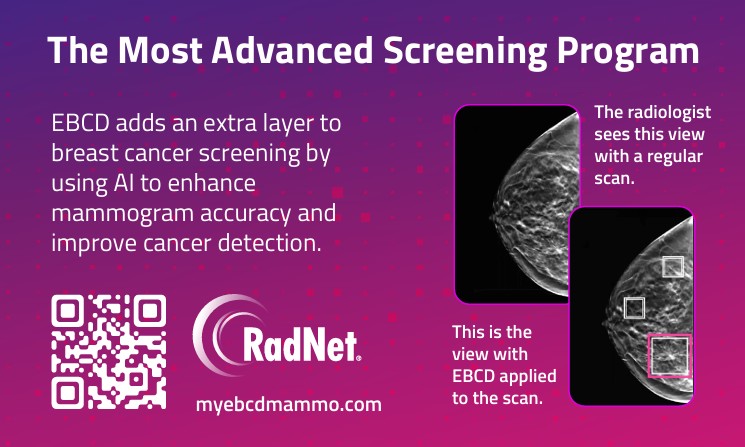
Enhanced Breast Cancer Detection (EBCD) Now Available
This advanced screening system combines the power of artificial intelligence with screening 3D mammography
for unmatched accuracy in breast cancer detection. Learn more here.
Genetic Counseling
Over the past several years, inherited factors, or genes, have been identified that can contribute to the development of some forms of breast, ovarian, colorectal and other types of cancer.
The Huntington Hospital Cancer Center offers hereditary cancer risk assessment and genetic counseling to people who are concerned about their personal and/or family history of cancer and risk to other family members.
The Role of Genetic Testing in Cancer
There are currently two breast cancer genes recognized:
- BRCA 1
- BRCA 2
These genes are involved in DNA repair, and when certain mutations in these genes are present, the ability of a breast cell to repair its DNA is hampered, and the cell becomes prone to becoming cancerous. To date, nearly a thousand mutations in the BRCA 1 and BRCA 2 genes have been identified, and many of these have been found to be associated with a significantly increased risk of breast cancer and ovarian cancer.
Important Breast Cancer Facts
- In the United States, one in eight women will be diagnosed with breast cancer in their lifetime.
- The majority of breast cancers are not hereditary. Therefore, the absence of a family history of breast cancer does not preclude a woman from being diagnosed with breast cancer herself. Conversely, the presence of a family history of breast cancer does not necessarily mean that your cancer is hereditary. In order to determine whether or not there is a significant family history that may be suggestive of a hereditary predisposition, your doctor will ask a for a detailed cancer history of your family tree.
Certain patterns of cancer in a family may indicate the presence of a BRCA gene mutation. BRCA gene testing is a DNA test which can be performed on either a blood sample or saliva sample. Most insurance plans will cover all/part of the test expense if you meet the appropriate criteria. If you meet any of these criteria, your doctor will discuss genetic testing with you, or refer you to a genetic counselor, medical geneticist, oncologist, or other health professional with expertise and experience in cancer genetics.
Should I Do Genetic Testing?
Identification of a deleterious BRCA mutation may have significant implications on your future risk of a new breast cancer or ovarian cancer, and may be helpful in helping you and your doctors determine the best treatment option and follow-up/surveillance plan for you.
The NCCN (National Comprehensive Cancer Network) has published a set of guidelines to help doctors determine when genetic testing may be appropriate in a breast cancer patient.
These include:
- Early age onset breast cancer ≤ 50 years old
- Triple negative [ER(-) PR (-) HER2/neu (-)] breast cancer ≤ 60 years old
- Two breast cancer primaries in a single individual (at the same time, or at different times)
- Breast cancer at any age with: ≥ 1 close blood relative (1st, 2nd, 3rd degree) with breast cancer ≤ 50 years old, or ≥ 1 close blood relative (1st, 2nd, 3rd degree) with ovarian/fallopian tube cancer at any age, or ≥ 2 close blood relatives with breast cancer and/or pancreatic cancer at any age
- Ovarian/fallopian tube cancer
- Male breast cancer
- Ashkenazi Jewish descent
Get the Cancer Care You Need
Call us to learn more about our trusted cancer services and to receive a physician referral.