 English
 Espanol
 简体中文
简体中文 Tagalog
 հայերեն
 한국인
한국인 Tiếng Việt
 فارسی
فارسی русский
 日本
日本 عربي
عربي
Lung Cancer Screening & Diagnosis
Lung cancer remains the leading cause of cancer-related deaths in the United States—claiming more lives than breast, prostate, and colon cancers combined. The primary reason? Late detection.
When caught early, lung cancer is often curable: for some early-stage cancers, the 5-year survival rate can exceed 90%. However, most cases are diagnosed at advanced stages when treatment options are limited.
Despite expanded U.S. Preventive Services Task Force (USPSTF) guidelines, lung cancer screening remains underutilized. Fewer than 14% of eligible Californians are screened, and Los Angeles County lags even further behind. This represents a critical missed opportunity to save lives.
The American Cancer Society estimates there are 226,650 new cases of lung cancer in the United States in 2025. The good news is that this number is decreasing, partly because fewer people are smoking, but also because of advances in early detection and treatment.
The Huntington Cancer Center is your partner for lung cancer diagnosis and the rest of your cancer journey
What is Lung Cancer?
Lung cancer is a term used to describe a growth of abnormal cells inside the lung. The cancerous cells stick together forming a cluster known as a tumor. There are two types of tumors: benign and malignant.
Benign tumors are not cancer. The cells do not spread to other parts of the body and the tumor often can be removed. These tumors are rarely life-threatening.
Malignant tumors are cancer. These cells divide and grow out of control and do not carry out the function of the organ they are inhabiting.
Visit the American Cancer Society to learn more about the types of lung cancer.
Get Screened
People aged 50 to 80 years old who have a 20-pack-year smoking history (that means one pack a day for 20 years, two packs a day for 10 years, etc.) benefit from annual screening. The screening test for lung cancer only takes a few minutes and is not painful. It is performed using a low-dose computed tomography (also called a low-dose CT scan). Be sure to ask your doctor for a screening referral if you meet these guidelines.
Lung Cancer Diagnosis
Frequently lung cancer is first discovered on a chest x-ray. Sometimes it is found incidentally on a routine chest X-ray, or an X-ray taken before an upcoming surgery. Other times the person may have respiratory symptoms such as nagging cough, coughing bloody sputum, difficulty breathing, wheezing or hoarseness. Other symptoms may include chest pain or pressure, swelling of the neck and face, loss of appetite, weight loss, or fatigue.
Diagnostic imaging is the cornerstone of diagnosis, staging and follow-up of patients with lung cancer and other malignancies of the chest. Regardless of how the tumor is initially discovered, the diagnosis of lung cancer is ultimately based on a biopsy that is examined by a pathologist under a microscope.
Screening & Diagnostic Services
- Positron emission tomography (PET/CT Scan)
- CT scan
- Magnetic resonance imaging (MRI)
- Bone scan
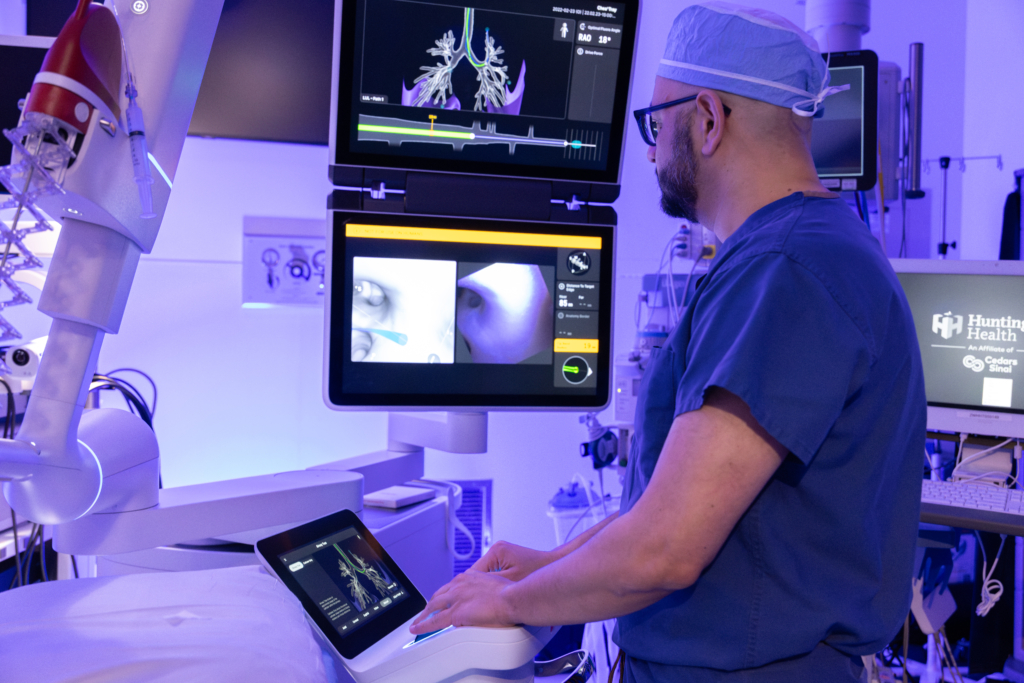
- Bronchoscopy (including robotic Ion bronchoscopy)
- Endobronchial ultrasound (EBUS)
- CT guided fine needle biopsy
To learn about low- or no-cost lung cancer screenings, visit www.hillmedical.com/lungscreening.
Leading Edge Diagnostic Technology
Ion
Through a robotic-assisted system called Ion, Huntington patients can now receive a minimally invasive, targeted lung biopsy, diagnosis and treatment all in one day. The procedure is now part of the Lung Nodule Program at Huntington Cancer Center.
Ion can precisely obtain a biopsy and resection (i.e., tumor extraction), reaching all 18 segments of the lungs through a patient’s airway using an ultra-thin, maneuverable catheter and integrated vision probe. The technology provides exact location and shape information, holding the catheter in place for precise placement for tools like a flexible biopsy needle.
By using Ion technology, doctors can diagnose lung cancer at an early stage and, in some cases, begin treatment during the same procedure. The technology reduces diagnostic time and is less invasive than traditional bronchoscopy, which makes the procedure gentler on patients, so they experience less discomfort and a shorter recovery.
According to the American Lung Association, finding lung cancer at a late stage puts a five-year survival rate at only 8%; finding it at an early stage increases the five-year survival rate to 63%. Follow-up CT scans to see if a nodule has grown and multiple biopsies prior to a lung cancer diagnosis can add months to a patient’s care journey, which can give the disease more time to advance (depending on the type of lung cancer, a tumor can grow twice its size in mere months). So, diagnosing cancer as soon as possible can lead to an improved survival rate for patients.
If you are interested in this procedure, please email Huntington Health’s Lung Nodule Program at LungNoduleProgram@HuntingtonHealth.org or call the Huntington Cancer Center at (626) 397-2524.
Get the Cancer Care You Need
Call us to learn more about our trusted cancer services and to receive a physician referral.