 English
 Espanol
 简体中文
简体中文 Tagalog
 հայերեն
 한국인
한국인 Tiếng Việt
 فارسی
فارسی русский
 日本
日本 عربي
عربي

When patients are informed that they need a lung biopsy – a sample of their lung tissue – to rule out cancer, time can seem to slow down. Where they go from there – scheduling a biopsy, undergoing surgery, waiting for results, then arranging medical interventions if need be – can seem like a long, scary road ahead. Fortunately, there’s a quicker, less invasive way for patients to get answers and treatment after a lung scan, and Huntington Health is now offering it to their patients. Through a robotic-assisted system called Ion, Huntington patients can now receive a minimally invasive, targeted lung biopsy, diagnosis and treatment all in one day.
The procedure is now part of the Lung Nodule Program at Huntington Cancer Center, led by Amirhossein Mahfoozi, MD, medical director of thoracic surgery and Huntington Health-affiliated pulmonologists Ayman Saad, MD and Hooman Sazegar, DO.
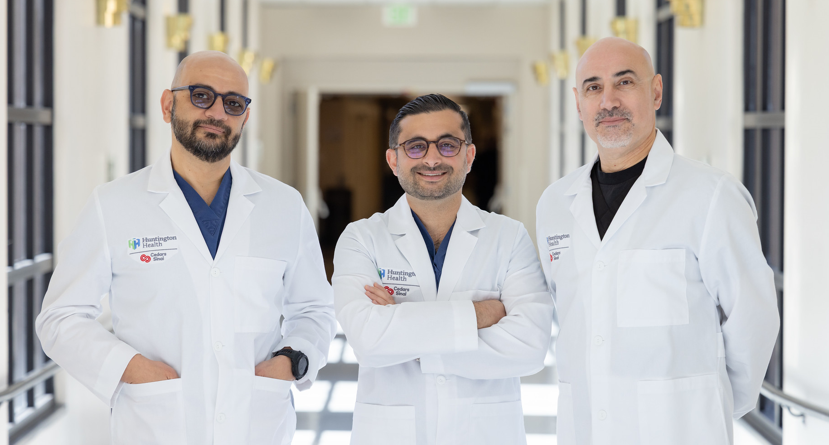
“A significant aspect of providing compassionate care involves anticipating the challenges that patients can face when presented with a new diagnosis. In the past, if a CT scan showed a suspicious nodule on the lung, the patient would have to be referred for a biopsy. This can involve a long wait time, meeting a new team of doctors, not to mention the inherent risks of an invasive procedure. There is also the wait-time from getting the biopsy to getting the results. Whether benign or otherwise, this can be agonizing. With Ion, the patient can be seen by one physician who performs the procedure and gives the results without having to navigate so many different aspects of the healthcare process,” said Dr. Saad.
Ion can precisely obtain a biopsy and resection (i.e., tumor extraction), reaching all 18 segments of the lungs through a patient’s airway using an ultra-thin, maneuverable catheter and integrated vision probe. The technology provides exact location and shape information, holding the catheter in place for precise placement for tools like a flexible biopsy needle.
“Another important benefit – the technology is less invasive than traditional bronchoscopy, which makes the procedure gentler on patients, so they experience less discomfort and shorter recovery,” Dr. Sazegar explained.
Ion’s benefit of reducing diagnostic time should also be stressed. According to the American Lung Association, finding lung cancer at a late stage puts a five-year survival rate at only 8%; finding it at an early stage increases the five-year survival rate to 63%. Follow-up CT scans to see if a nodule has grown and multiple biopsies prior to a lung cancer diagnosis can add months to a patient’s care journey, which can give the disease more time to advance (depending on the type of lung cancer, a tumor can grow twice its size in mere months). So, diagnosing cancer as soon as possible can lead to an improved survival rate for patients.
“Use of leading-edge technology to improve patient experience and outcomes is one way Cedars-Sinai Cancer and its affiliates are bringing the best possible health care to the people we serve throughout the region,” said Karen Reckamp, MD, director of the Division of Medical Oncology and professor of Medicine at Cedars-Sinai. “The Lung Nodule Program is an example of that care in action.”
By using Ion technology, doctors can diagnose lung cancer at an early stage and, in some cases, begin treatment during the same procedure.
“Ion allows us to biopsy multiple spots in the lungs-even on both sides-at the same time,” says Dr. Mahfoozi. “It also helps us reach areas that are difficult or impossible to access with traditional CT-guided biopsy, all with a strong safety record.”
Early detection is one of the most important factors in improving survival rates. The earlier lung cancer is found and treated, the better the outcome for patients. “The Ion robotic bronchoscopy truly elevates lung care for our patients at Huntington Hospital,” said Dr. Mahfoozi.”
If you are interested in this procedure, please email Huntington Health’s Lung Nodule Program at LungNoduleProgram@HuntingtonHealth.org or call the Huntington Cancer Center at (626) 397-2524. To learn more, go to: Lung Cancer Screening & Diagnosis | Huntington Hospital